- The Wod - by Skyfit
- Posts
- Lactate Threshold - Feel the Burn
Lactate Threshold - Feel the Burn
Let's look into lactate threshold and how use it to train as well as improve it

Joshua Berkowitz
October 04, 2023

Lactate Threshold - Feel the Burn
Vol. 11

Don’t be this guy, it’s actually detrimental to you.
Calling all Office Warriors!!! We’re gathering our community for the Sky:30 fitness challenge. This fitness challenge includes:
Personalized 1:1 goal setting & workout programming
Online coaching & accountability sessions
Deep insight into your fitness data to make your fitness goals efficient, attainable, & fun!
We are one of the few online personal trainers tracking lactate threshold for our Office Warriors. Learn more & sign up to get early access here.
In This Article, We…
Talk about Lactate Threshold (what it is, why it’s important).
Show how you can use your smartwatch to determine your Lactate Threshold.
Demonstrate how and why Lactate Threshold should be used in your training.
Last week, we covered VO2 Max and highlighted its importance in demonstrating overall health and wellness. VO2 max is a very important indicator of health, but it’s hard AF to train at VO2 max capacity.
A measurement that is on the precipice of wearable technology is your Lactate Threshold.
Lactate threshold is the exercise intensity at which lactate (lactic acid) starts to build up in your blood, causing fatigue and reduced performance. It is a key indicator of your running potential and fitness level and is tied to your VO2 Max (because it’s a result of exercising really effing hard).
Knowing your lactate threshold can help you improve your running performance in several ways:
You can use it to set realistic goals for different race distances
You can use it to monitor your progress over time
You can use it to optimize your training zones
How Do I Find Out What My Lactate Threshold Is?
Unfortunately, Garmin is the only major smartwatch that provides a way to test Lactate Threshold. However, there are effective ways to get a manual calculation that you can utilize to guide your training.
See here for instructions to utilize your Garmin device to find Lactate Threshold.
For Everyone Else - Apple Watch, Fitbit, Whoop, & the Gamut
We are going to be doing what’s called the Time-Trial Method.
Find a smooth, flat surface such as a treadmill or a track
Start with your wearable device turned on and track your heart rate for any kind of running or cardio work
Run for 30 minutes at the fastest pace you can hold for that amount of time (don’t start too fast).
Measure your heart rate after ten minutes of activity.
At the end of the 30 minutes measure your heart rate.
You then have the following formula to give you your Lactic Threshold.
(HR10min + HR30min)/2Example
HR at 10min - 165
HR @ 30 min - 178
(165+178)/2 = 172
Okay, So What Do I Do With This Number?
In order to increase my lactate threshold, and therefore increase my overall cardiovascular endurance (and my VO2 max), I should train at 172 HR BPM.
This should be the point right before you hit the beginning of anaerobic exercise as depicted below.
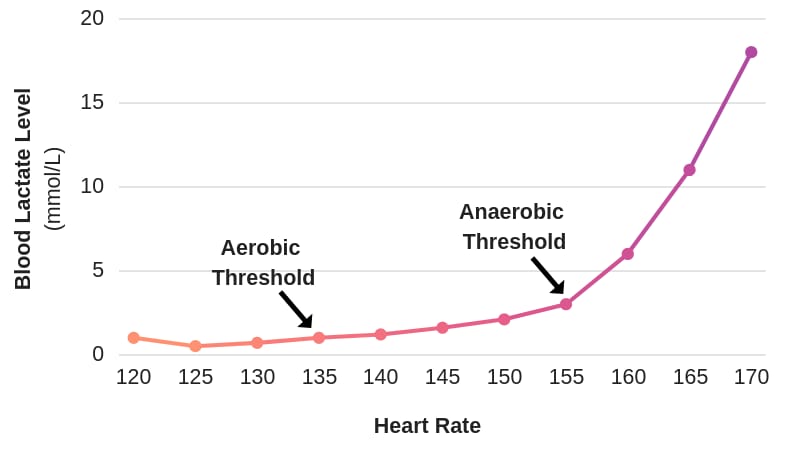
How to Structure a Basic Workout to Improve Lactate Threshold
One of the major effects of lactate threshold training is an improved lactate profile, which means lower blood lactate levels at the same intensity. This allows you to run faster for longer (it’s like being able to bench the same weight more times for you meatheads out there).
There are different types of workouts that can improve your lactate threshold, such as tempo runs, intervals, hill repeats, and grinders3 .
Here are some examples of basic workouts that you can do once or twice a week:
Tempo Run
A tempo run is a continuous run at an intensity close to or slightly above your lactate threshold. It improves your ability to sustain a high pace for a long time.
Warm up for 10 minutes at an easy pace.
Run for 20 minutes at an average heart rate about 5 beats below or above your LT heart rate.
Cool down for 10 minutes at an easy pace.
Intervals
Intervals are short bouts of high-intensity running followed by recovery periods. They improve your ability to clear lactate from your muscles and blood.
Warm up for 10 minutes at an easy pace.
Run for 5 minutes at an average heart rate about 10 beats above your LT heart rate.
Jog for 2 minutes at an easy pace.
Repeat steps 2 and 3 for a total of 4 to 6 times.
Cool down for 10 minutes at an easy pace.
Hill Repeats
Hill repeats are repeated runs up and down a hill. They improve your strength, power, and lactate tolerance.
Warm up for 10 minutes at an easy pace on flat terrain.
Find a hill that takes 3 to 5 minutes to climb at a hard effort.
Run up the hill at an average heart rate about 15 beats above your LT heart rate.
Jog or walk down the hill at an easy pace.
Repeat steps 3 and 4 for a total of 4 to 6 times.
Cool down for 10 minutes at an easy pace on flat terrain.
Grinders
Grinders are long climbs at a steady intensity. They improve your endurance, efficiency, and lactate clearance.
Warm up for 10 minutes at an easy pace on flat terrain.
Find a long climb that takes 10 to 30 minutes to complete at a moderate effort.
Run up the climb at an average heart rate about 5 beats below your LT heart rate.
Jog or walk down the climb at an easy pace.
Repeat steps 3 and 4 for a total of 2 to 4 times.
Cool down for 10 minutes at an easy pace on flat terrain.
We are also tracking your lactate threshold as part of our Sky:30 fitness challenge. click the link here to learn more & sign up for The Sky:30 Fitness Challenge + FitReview.
- JT & Phil
Want to learn more?
Something we missed or misspoke?
Want to hear on a specific topic?
Reply to us here and we’re happy to chat and help you learn more about your wearable.
Reply