- The Wod - by Skyfit
- Posts
- Is Your Watch Lying To You?
Is Your Watch Lying To You?
Your watch may not be right (we're not talking about the time).

Joshua Berkowitz
August 23, 2023

How Accurate Is My Watch?
Vol. 5

Analysis from Rob ter Horst’s baseline testing for different wearables
Are you an Office Athlete and want to get more out of your data? We’ll break down your data for you and offer insights on how to train smarter, for free. Email us here to set up a call with us.
Money for Metrics
Your wearable delivers some incredible insights. From simple things such as Heart Rate to complex measurements like blood oxygen concentration (SPo2), and Vo2 max, smartwatch companies are working hard and fast to differentiate themselves and beat their competition.
But who the hell needs to know their SPo2, Vo2max, or care about Garmin’s Tactix 7 “Night Vision Mode”. Watches are expensive, as we all know, and it’s important to spend your money on the right metrics.
If you’re like us, an office warrior but not a Navy SEAL, you should prioritize the most important aspects of your health for longevity and not every bell or whistle presented to you.
These metrics are heart rate, sleep, and step count, all of which play into one big fancy term known as Total Daily Energy Expenditure.
What’s a Total Daily Energy Expenditure?
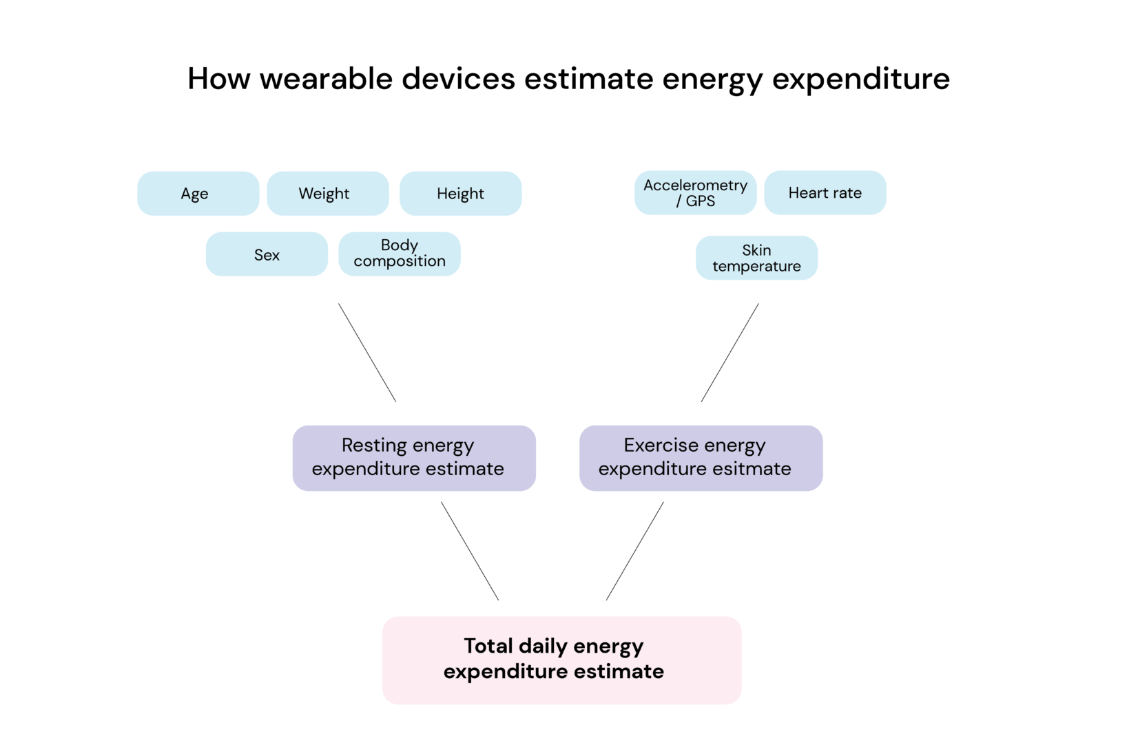
Overview of how your watch determines daily energy expenditure
Simply put, it’s energy expenditure (calories burned) as a result of being a live human being. Bodily processes like breathing, sitting, and even fidgeting contribute to the energy you expend. As you move through your day, your watch continuously sends your data off to be processed and a fancy schmancy number shows up on your screen. Each company has its own algorithm and the quality of data it receives is dependent on the hardware and software your device is running.
Where Measurements Go Wrong
Due to the varying accuracy of your wearable readings, the inputs to these fancy algorithms can be inaccurate, which then leads to skewed results when it comes to your TDEE.
This is troublesome for 2 main reasons:
Difficulty quantifying your health metrics accurately
Interferes with personal interpretations of your health goals
An article from Macrofactor wrote: “If you think you burned a total of 1000 calories jogging last week, it’s entirely possible that you actually burned 1345 calories, but it’s also possible that you only burned 655 calories.”
So, basically, your watch can be inaccurate between 2% - 60% of the time. That ain’t it chief, and can lead you to have an unhealthy approach to exercise eating disorders and mental health decline (we’re guilty of this too). Because of this, some fitness icons choose to avoid wearables altogether.
So is My Wearable Useful?
Absolutely, however, the focus shouldn’t be on the numbers you see every day, but rather on the overall trends in your data, and most importantly, how you feel.
While there is known error baked into these metrics, your wearable should be used as a long-term health tool for metrics like heart rate and step count. But for something more specific like TDEE, you should meet with a healthcare provider (dietitians are a great option) to receive more specific guidance on your caloric expenditure. Over time your data will start to change as you make changes in your daily habits.
Interested in better understanding these changes? Reach out to us here to get started better understanding yourself through your wearable data.
Our advice? When it comes to being proud of that 10k step count, or 5k run, or crazy ultramarathon, lead with your heart, not your wrist.
- JT & Phil
Deep Dive
Watch
Rob ter Horst’s breakdown of each wearable’s ability to accurately measure heart rate.
Gatorade releases a hydration patch that measures sweat rate, fluid loss, and sodium loss.
Read
Macrofactor details the drawbacks of using wearable devices to inform nutrition targets.
Want to learn more?
Something we missed or misspoke?
Want to hear on a specific topic?
Reply to us here and we’re happy to chat and help you learn more about your wearable.
Reply